
Columbia County Criminal History Checks
Start with the office tied to the event. Columbia County Court keeps superior criminal cases at 401 Union Street in Hudson. Hudson City Court keeps city misdemeanor and violation cases, while each Town or Village Justice Court keeps its own local docket. The New York Court Locator identifies the right local clerk. WebCrims can reveal a future appearance, but a clerk remains the best source for a completed case, a certificate of disposition, or papers that are not online.
Prepare the full legal name, date of birth, known aliases, approximate incident date, arresting agency, and any docket, indictment, superior court information, or report number. Exact spelling matters. A public court result can miss a name variation, and an old town-court record may fall within a reporting gap. The aim is to match the person and event before drawing a conclusion.
- Identify the court or arresting agency that created the record.
- Use WebCrims for a future date, or ask the local clerk for the docket and disposition.
- Use OCA CHRS only when an exact-name statewide public court search fits the need.
- For your own fingerprint-supported history, schedule a DCJS Personal Record Review.
- Compare each arrest charge with the filed charges and final result, then seek a correction if they do not reconcile.
Note: A no-result screen may reflect spelling, timing, court coverage, sealing, or a transfer rather than the absence of a record.
Columbia County Warrant Record Checks
No verified public Columbia County warrant list was found. A suspected bench warrant should be checked with the court that issued it, using the name, case number, issue date, and underlying charge when known. Sheriff dispatch may confirm information it is allowed to release, and FOIL can seek an identifiable existing record, but neither route lets staff cancel a warrant. Only the issuing court can recall or vacate it.
For your own suspected warrant, contact legal counsel before appearing at a jail or courthouse without a plan. Ask the clerk about scheduling or surrender procedure and the permissible bail method. After the matter is resolved, obtain the docket entry, minutes, or certificate showing the court action. Law-enforcement databases may need time to reflect the change.
Warrant caution: An empty public search is not clearance. Confirm status with the issuing court before relying on it.
No Single Columbia County Criminal Records Portal
Columbia County's rural court map is the reason. County Court handles felony prosecutions, Hudson City Court handles matters within city jurisdiction, and many Town and Village Justice Courts create separate misdemeanor, traffic, arraignment, and warrant files. The elected County Clerk also offers an IQS public index, but that system is not the criminal docket. A land or index search there should never be treated as a criminal case result.
Records also split by purpose. An agency report describes an allegation and investigation. The jail tracks booking and release. A court file shows what prosecutors filed and how each count ended. DCJS joins fingerprint-supported arrest cycles with reported outcomes for the subject's own review. This chain is more useful than hunting for a supposed countywide database that does not exist.
The Columbia County Sheriff's Office page shows the local law-enforcement hub.
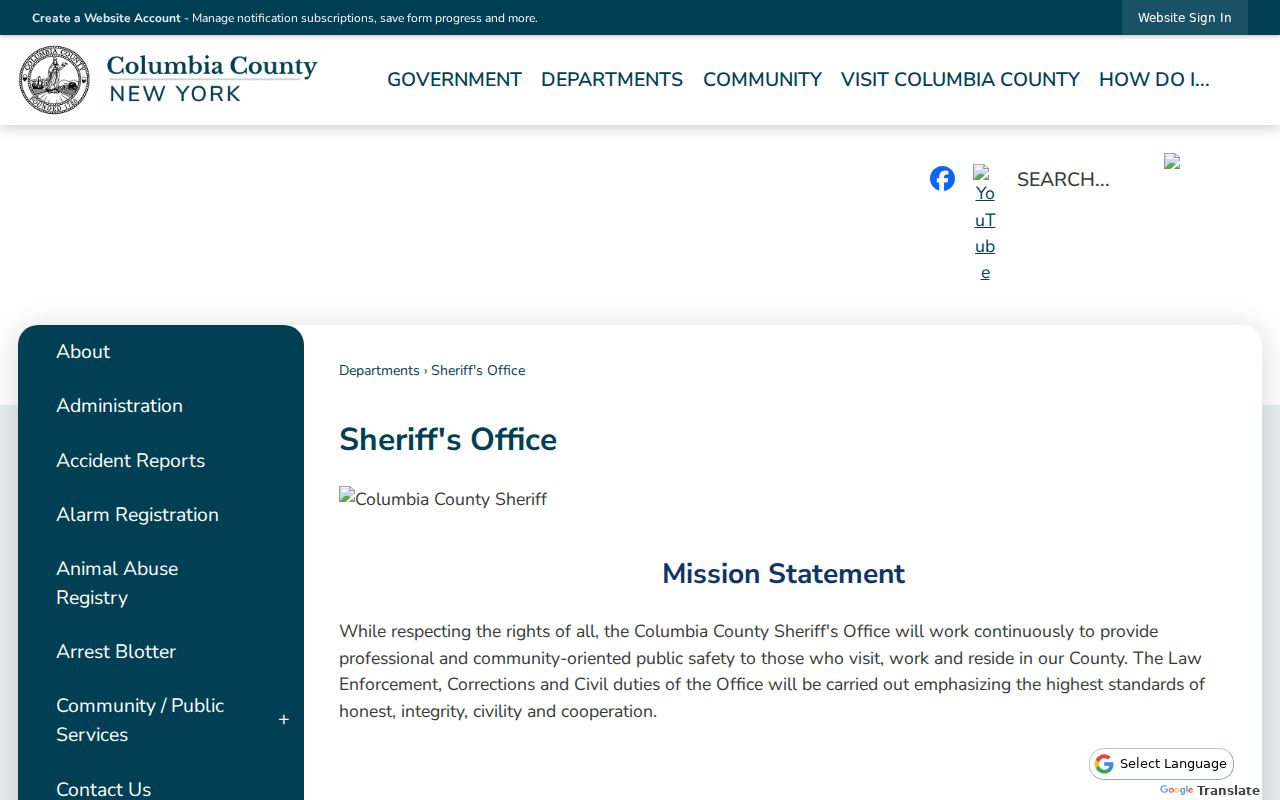
The official page anchors sheriff reports, jail calls, and local records at the Public Safety Facility rather than promising one all-purpose search.
Official Background Checks in New York
The New York State Division of Criminal Justice Services is the central fingerprint repository. A person may request their own DCJS Personal Record Review, but the public cannot order someone else's DCJS rap sheet. An unsuppressed response is the stronger diagnostic choice for self-review because it may include sealed or suppressed events the subject is allowed to see. A suppressed response leaves that material out. Both products include challenge directions when an arrest cycle lacks a matched disposition or another detail appears wrong.
The official DCJS record-review instructions distinguish a repository self-review from a public name search.
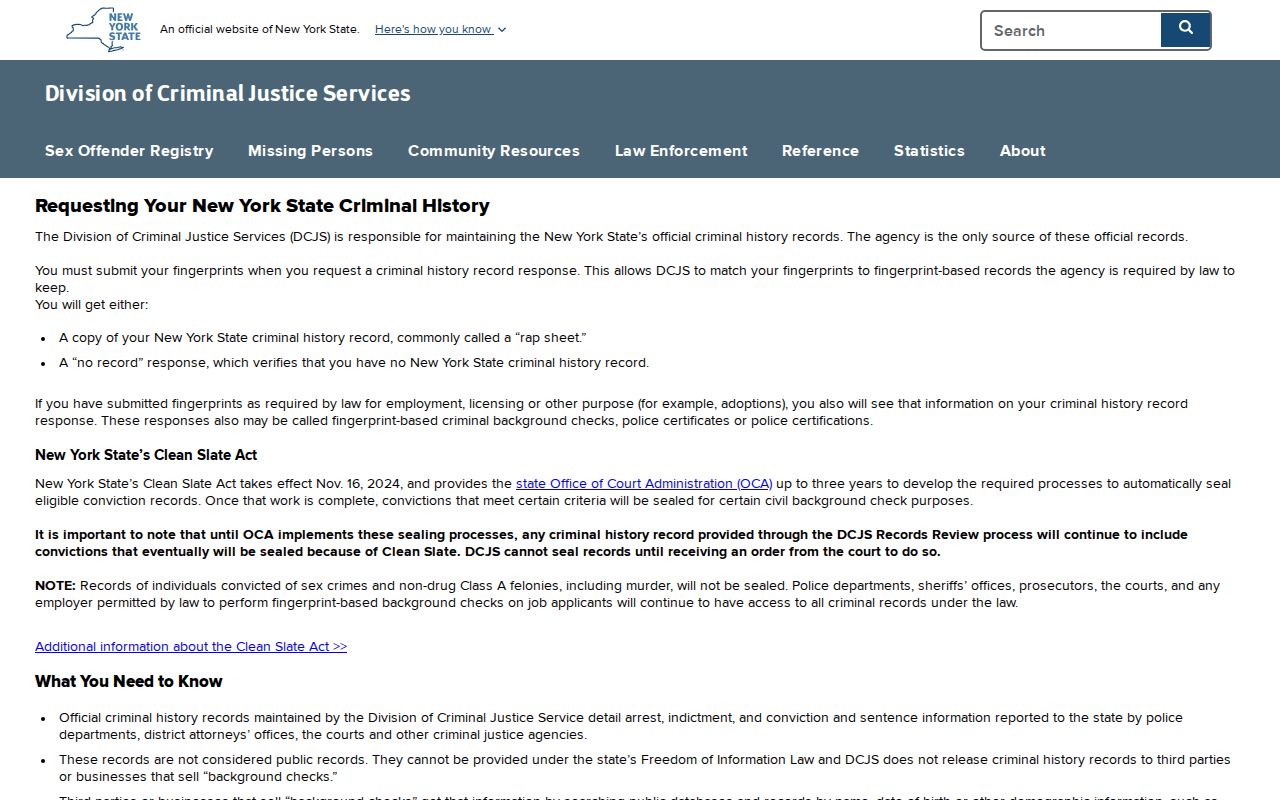
The state page also explains suppressed and unsuppressed responses, fingerprint enrollment, fee waivers, and the correction process.
New York residents enroll through IdentoGO with ORI NYDCJSPRY. The current DCJS fee is $17.50, effective February 2, 2026. Official pages do not publish a stable Columbia County storefront, so check the vendor locator with a Hudson-area ZIP. Out-of-state Cardscan uses service code 15464Z for a suppressed response or 15465F for an unsuppressed response.
The IdentoGO enrollment system is the official fingerprint scheduling route.
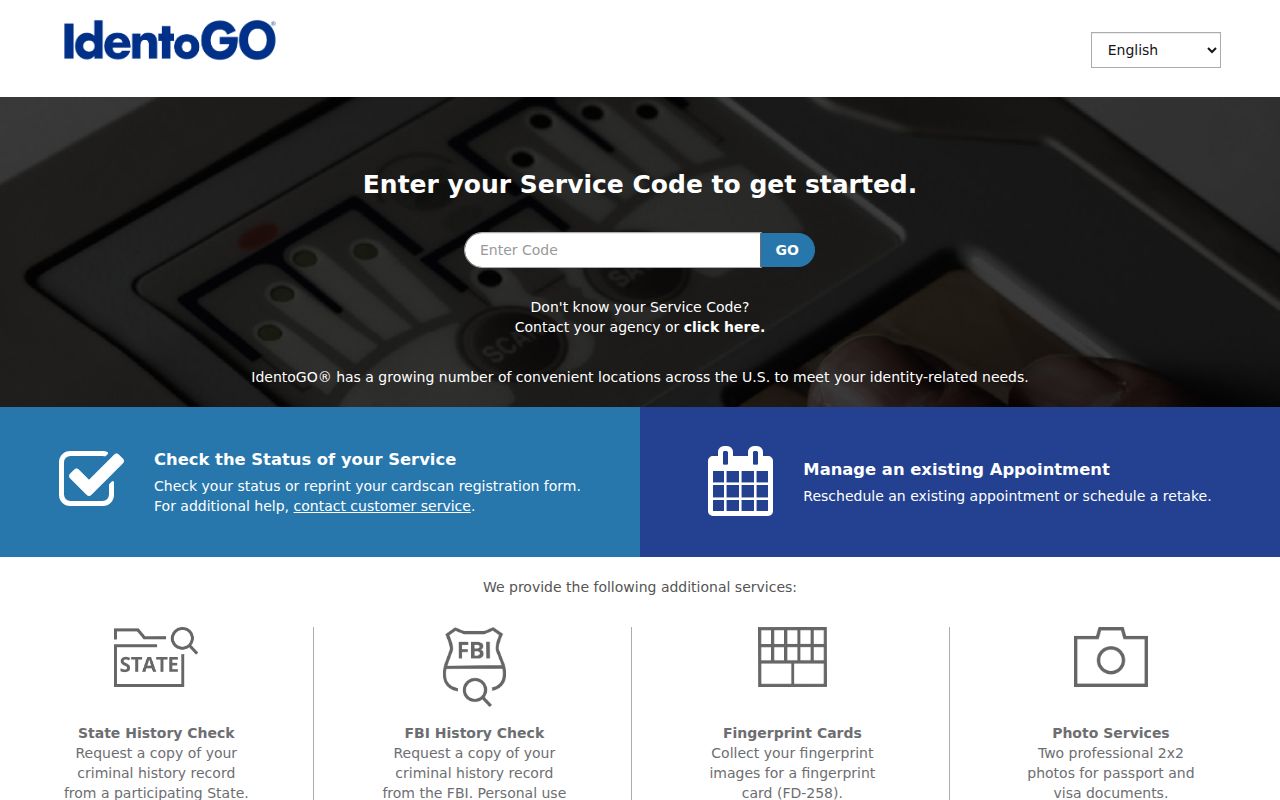
Entering the DCJS service information before selecting a site helps avoid an appointment for the wrong fingerprint product.
DCJS and OCA Columbia County Record Checks
These two New York products answer different questions. DCJS uses fingerprints and is limited to the subject or the subject's attorney. OCA Criminal History Record Search uses an exact name and date of birth, costs $95 per search, and returns public open cases and convictions reported by criminal courts across the state. CHRS is not certified, excludes sealed matters and federal cases, and has historical Town and Village Court gaps. It cannot stand in for a fingerprint-supported rap sheet.
| Channel | Best use | Key limit | Fee |
|---|---|---|---|
| DCJS Personal Record Review | Review your own New York repository record | Fingerprint-based and not available for another person | $17.50 |
| OCA CHRS | Search public statewide court history by exact name and DOB | Not certified; exclusions and local historical gaps apply | $95 |
| FBI Identity History Summary | Review your own federal fingerprint history | Separate federal scope | $18 |
The OCA CHRS service page explains its current access rules.
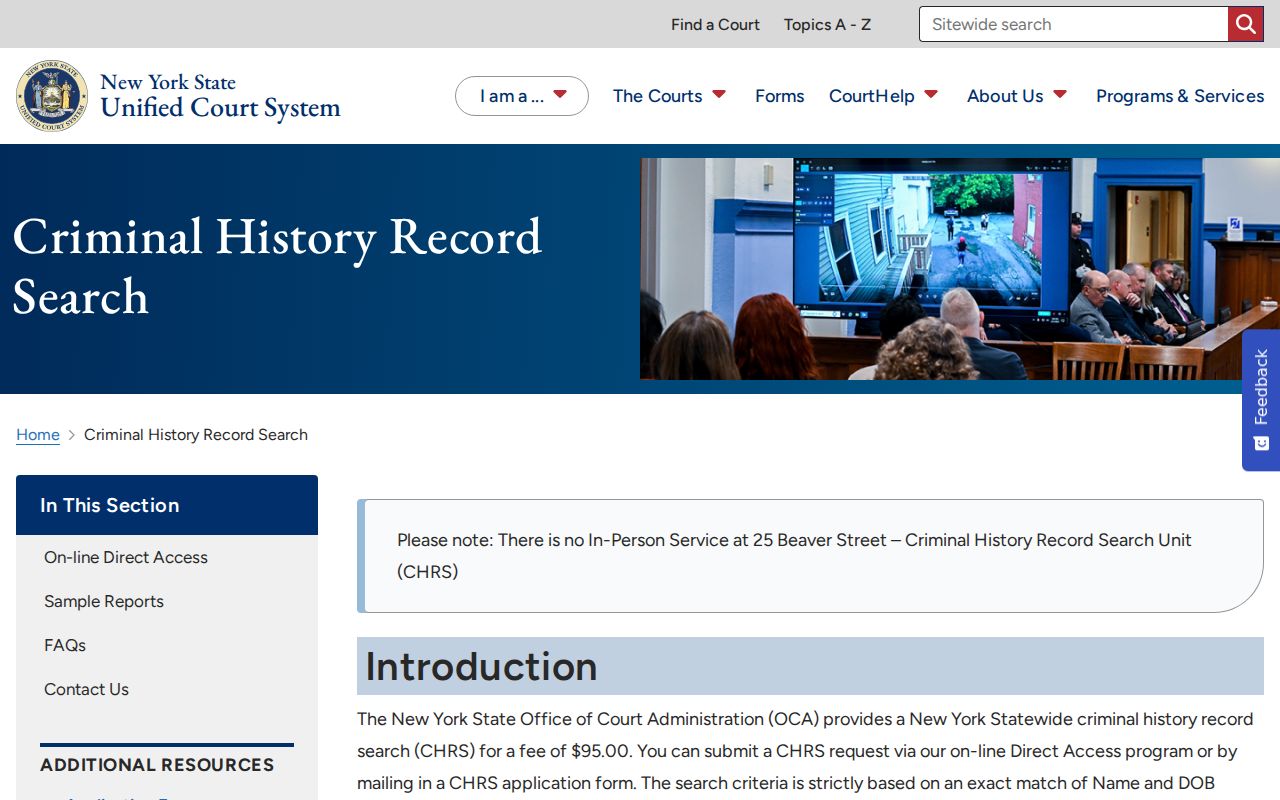
The official search description makes clear that CHRS reports public court history, not the private DCJS repository file.
Kinds of Criminal Records
Each record type has its own custodian and meaning. Police and sheriff reports begin with allegations. Jail records begin at intake. The prosecutor may change the charge theory before the court receives a complaint, information, superior court information, or indictment. The court then records appearances, motions, pleas, verdicts, and sentence. Columbia County criminal history is most accurate when those stages are kept separate.
- Incident and arrest reports: requested from the sheriff, Hudson Police, another local department, or New York State Police that created them.
- Booking and custody records: held by Columbia County Jail for local custody, with DOCCS records used after a state transfer.
- Court case files: held by County Court, Hudson City Court, or the responsible Justice Court.
- Warrant records: tracked by the issuing court and law enforcement, with no verified public Columbia County warrant list.
- Supervision and registry records: divided among Columbia County Probation, DOCCS, and the New York State Sex Offender Registry.
For a closer look at filed counts and final outcomes, use the Columbia County court case lookup. Arrest details and booking limits are addressed through the separate arrest channels.
Four Columbia County Arrest Records
One arrest can create four records without producing four identical accounts. The arresting agency states the suspected offense and describes the event. Jail staff create a custody file and send fingerprints for qualifying arrests. Prosecutors decide which accusations become filed counts. The court records the plea, dismissal, trial result, and sentence. DCJS later tries to match the fingerprint cycle with the reported disposition.
Record flow: Agency report › jail booking › filed court case › reported DCJS disposition.
- Arraignment
- The first court proceeding where charges are stated and release, counsel, or bail issues are addressed.
- Disposition
- The result of the case or of one individual charge.
- Superior court information
- A felony charging paper used when indictment is lawfully waived.
- Undisposed arrest
- A DCJS cycle that lacks a matched final result, not proof that the case remains open.
A certificate of disposition from the sentencing court is the portable proof of what happened. When it conflicts with a DCJS response, send it through the challenge process included with the rap sheet.
Columbia County Records: What They Contain
A public court file is procedural, while a rap sheet is organized around fingerprint cycles and a jail file around custody. Names, dates, and charges may be repeated across all three, but the context changes. Read the disposition for each count rather than relying on a single status label. Protected victim, juvenile, financial, grand-jury, and sealed information is not part of an ordinary public response.
| Name and identifiers | Reported legal names, aliases, date-of-birth details within access limits, NYSID on repository records, and court or custody identifiers. |
|---|---|
| Arrest and booking data | Arrest date, agency, intake, booking number, holding status, bail or remand, and release or transfer data. |
| Charges and statutes | Offense text, statutory section, classification, and separate arrest, filed, and conviction counts. |
| Disposition | Plea, conviction, dismissal, acquittal, adjournment, or another result for each charge. |
| Sentence | Incarceration, probation, post-release supervision, fine, surcharge, or restitution where public. |
| Custody or supervision | County jail status, state facility data, probation sentence, or parole and post-release information within disclosure rules. |
Note: An arrest charge can be amended, reduced, dismissed, or replaced, so only the court disposition establishes the criminal outcome.
No Columbia County Jail Records Roster
Columbia County publishes no verified live inmate roster. For current local custody, call jail reception at 518-828-3324 or contact the Public Safety Facility at 85 Industrial Tract, Hudson. A sheriff FOIL request can seek an identifiable booking record. VINE may provide notification, but it is a supplement. If the person was transferred after a state sentence, switch to the DOCCS Incarcerated Lookup.
The facility opened in 1989 with a 135-bed design and handles pretrial custody, local sentences of one year or less, and some federal or overflow placements. Those figures describe its role, not current occupancy. Release on recognizance, an appearance ticket, bail, transfer, or an internet-removal rule can all explain why someone is not found in a particular channel.
The official state incarcerated-person search illustrates the state-custody fallback.
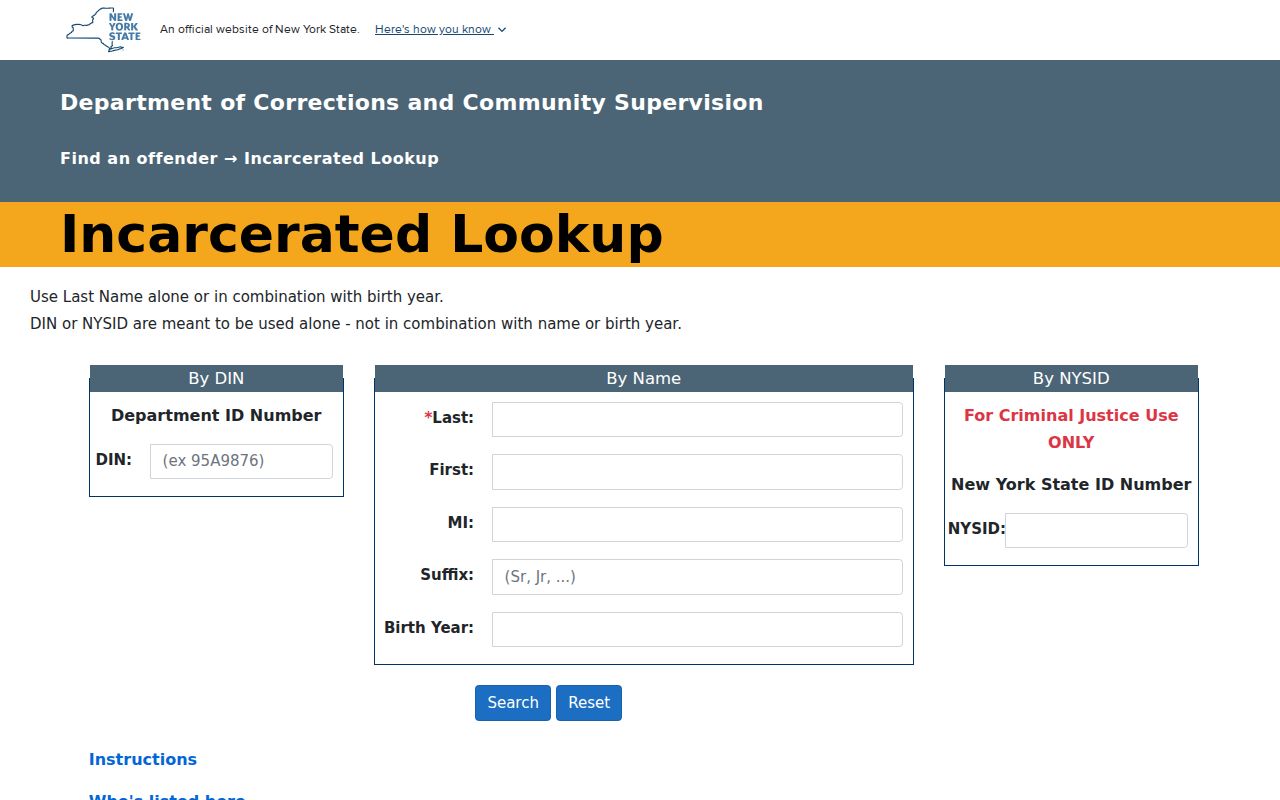
Searches may use a DIN, NYSID, or name, but statutory omissions mean a missing result is not a complete lifetime custody statement.
New York Public Access Laws
New York law favors access to agency records but preserves specific limits. FOIL reaches existing sheriff and police records; it does not compel a new explanation or override sealing. Court clerks search and certify files under a separate rule. DCJS limits repository review to the subject, and criminal procedure statutes seal eligible outcomes. Ask for public, segregable portions when part of a report may be withheld.
Key statutes:
Public Officers Law Article 6 gives the FOIL process, exemptions, fees, and appeal rights.
Judiciary Law §255 directs clerks of courts of record to search and certify lawfully available files.
CPL §160.50 seals records after qualifying favorable terminations.
CPL §160.57 governs automatic Clean Slate sealing for eligible convictions.
CPL §160.59 permits an application to seal certain older convictions.
Grand-jury material, youthful-offender and juvenile records, sealed files, protected victim data, and active-investigation details remain limited. Registry information also carries strict anti-harassment warnings.
Columbia County Sheriff Records by FOIL
The Sheriff's Office separates arrest blotters, report copies, accident reports, record checks, and FOIL requests. Use the specific product page first. When no routine route fits, the Sheriff's FOIL channel accepts a focused request by mail or at the Public Safety Facility. Give the incident date range, location, agency, report number if known, people involved only as needed, desired format, and whether inspection or copies are sought.
FOIL generally calls for access, denial, or acknowledgment within five business days. A denial may be appealed within 30 days. Photocopies up to 9-by-14 inches may cost as much as 25 cents per page unless another fee applies, while other reproduction can be charged at actual cost under the statute. No fixed county fee was confirmed for every sheriff product, so verify the amount before ordering.
| Need | First channel | Fallback |
|---|---|---|
| Sheriff incident or arrest report | Obtaining Reports or arrest blotter page | Sheriff FOIL request |
| Hudson Police report | Hudson records application | City Records Access Officer |
| State Police report | NYSP FOIL portal | Contact the responsible troop |
| Suspected warrant | Issuing court clerk and legal counsel | Sheriff dispatch for permissible confirmation |
Restricted, Sealed & Expunged Records
New York uses record sealing rather than broad record destruction. CPL 160.50 covers many cases that ended in the accused's favor. CPL 160.55 applies to specified violation and traffic outcomes, while CPL 160.58 addresses certain treatment-linked convictions. CPL 160.59 allows a court application for a limited set of older convictions. Eligibility turns on the full history, offense type, waiting period, and pending cases.
Clean Slate under CPL 160.57 took effect in 2024 and gives OCA a phased implementation period. Eligible misdemeanors generally use a three-year waiting period and eligible felonies an eight-year period after sentence completion, subject to incarceration and new-case rules. Sex offenses and non-drug Class A felonies are excluded. Sealing limits ordinary civil access but does not erase the record or bar every justice-agency use.
In Columbia County, obtain a certificate of disposition from the sentencing court, compare it with the correct statute, and use the Unified Court System forms for any application. Keep the signed order. After processing, compare the court view with a new DCJS Personal Record Review and use the DCJS challenge route if a cycle still appears incomplete.
Columbia County Probation and Parole Records
Probation and parole are different systems. Columbia County Probation conducts presentence work, supervises local probation, and runs pretrial, alternative-sentencing, juvenile, and diversion services. There is no public county probation roster. Confirm a probation sentence through the court disposition first, then ask the department what it may lawfully disclose. Case notes, treatment information, and special conditions can remain private.
DOCCS controls parole and post-release supervision. Its Parolee Lookup accepts NYSID, DIN, name, and birth year, but its warning says the generated information is not guaranteed complete. A prior offense outside the current sentence may not appear. A probation violation also creates a separate court trail that can include a petition, appearance, warrant, hearing, modification, or resentencing.
The Columbia County Probation directory identifies the county office and its services.
The office listing is the right place to verify current contact details before relying on an older address during the county's planned service consolidation.
City-by-City Criminal Records in Columbia County
Hudson is Columbia County's only incorporated city. Hudson Police creates its own incident and arrest material, and Hudson City Court handles city misdemeanors, violations, arraignments, and preliminary felony steps. County Court, the sheriff, and state agencies remain separate even when their offices have Hudson mailing addresses. The local page follows the weekly police logs, city FOIL form, City Court file, and county-custody handoff without padding the list with villages or towns.
Hudson Record Check
Population estimate 5,721 · Hudson Police weekly logs and Hudson City Court records
A city arrest log is not a conviction list, and it may rotate away. Preserve the incident date and report details, then obtain the court disposition for the lasting result.